
Xuanfeng Accelerator Global Node Expansion

Over the past six months, "no node in this region" ranked in the top five support complaints. Users in Southeast Asia, South America and the Middle East often had to route through other regions with latency above 200ms. On September 4, 2026, Xuanfeng Accelerator completed an expansion adding 120 servers across six countries.
This expansion is not simply adding machines, but a systematic fix for "coverage gaps" and "peak congestion". We analyzed 90 days of node load data to find regions above 80% load and uncovered countries with rising requests.
1. The user demand behind expansion
Data shows requests from Southeast Asia (Vietnam, Thailand, Indonesia) grew 2.3x over the past year while node count rose only 30%, a severe imbalance driving high latency. South America and the Middle East were coverage gaps, forcing users through North America or Europe, doubling latency.
"More nodes" was never the goal; "connectable and fast" is. So the principle this round: fill gaps in high-growth regions and relieve congested areas.
2. New regions and investment
The six new countries are Vietnam, Thailand, Indonesia, UAE, Brazil and South Africa, totaling 120 servers with NVMe storage and 10Gb NICs, adding 320Gbps of bandwidth. Vietnam and Thailand get 30 each, Indonesia 20, and UAE, Brazil, South Africa 10-15 each.
| Country | Servers | Bandwidth | Purpose |
|---|---|---|---|
| Vietnam | 30 | 80Gbps | SEA growth |
| Thailand | 30 | 80Gbps | SEA growth |
| Indonesia | 20 | 60Gbps | Fill gap |
| UAE | 15 | 40Gbps | Middle East |
| Brazil | 15 | 40Gbps | South America |
| South Africa | 10 | 20Gbps | Africa |
Besides hardware, we upgraded backbone connections and reached direct peering with local ISPs to avoid return detours. In Vietnam, for example, all new nodes connect to local IXPs, so local-site traffic stays in-country and latency drops from ~180ms to ~45ms.
3. What users can feel
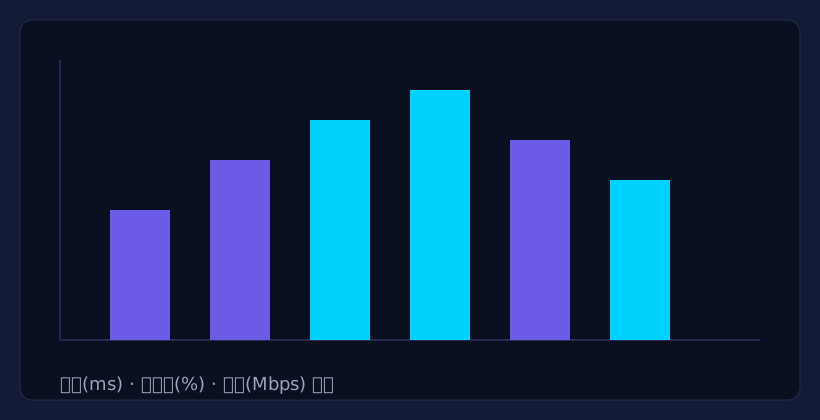
The most direct change is latency. After launch, average latency in Southeast Asia dropped 38%; South American users went from "routing through North America" to "local direct", down over 50%. Congested regions also saw load fall and fewer peak-hour disconnects.
"In Bangkok, I used to route through Vietnam. Now with a local node, streaming finally stops buffering." — feedback from Thai user "Somchai".
| Region | Before | After |
|---|---|---|
| Southeast Asia | 148ms | 92ms |
| South America | 210ms | 98ms |
| Middle East | 180ms | 110ms |
Back to the coverage-gap and congestion demand: this round fills a big part. Node building is continuous, and we will keep evaluating load and demand. Check your region in the client node list, or free VPN download the latest client.
User Comments
243 collected, curated below.
Local nodes are a game changer; no more high-latency detours, streaming is smooth.
South America finally has local nodes, no more routing through North America, latency halved.
Indonesian nodes came just in time, much more stable now.